Is the Vent app shutting down, and where should you go instead?
Yes, the original Vent app is gone. Vent (vent.co) was for years the most recognized name in this category, and it retired its consumer app: vent.co returned a 404 when we first checked in May 2026 and still did when we re-verified on July 10, 2026. There is no official successor, so the practical move is to match what you used Vent for to an app that still exists. If you used Vent to post feelings and get supportive reactions from strangers, Sincerely is the closest living equivalent: anonymous letters with community responses and a large, active user base. If you want anonymous real-time chat with zero account friction, VentSpace fills that gap, and Virtual Friend Shoulder is the biggest Android-side community. If you want an actual human responding one-on-one, 7 Cups' trained listeners still operate on the web (its iOS App Store listing currently returns a 404 in the US store, so use the website). And if years of broadcasting vents into a feed changed nothing, that is the gap the AI companions target: Vent Now listens and reflects your patterns back, and ILTY (which we make) listens fully and then pushes the vent toward a concrete next step. Every app on this list was re-verified as alive in July 2026.
What is needtovent.io? Is it a venting site?
No. When we checked it in a browser on September 22, 2026, needtovent.io was not a venting service. The domain was registered in October 2025. Its links open a one-on-one chat styled like a messaging app and presented as a named, "verified" woman, which opens with scripted flirting messages and photos. The site's code and network requests go to CupidBot, which describes itself as "AI bots that work your social media DMs and funnel fans to your paywall." We found no disclosure in the chat that you're talking to automated software, and no venting feature. If you want to vent, every app on this page says what it is, and our venting websites roundup covers options that work in a browser with no account.
Is there an AI you can vent to?
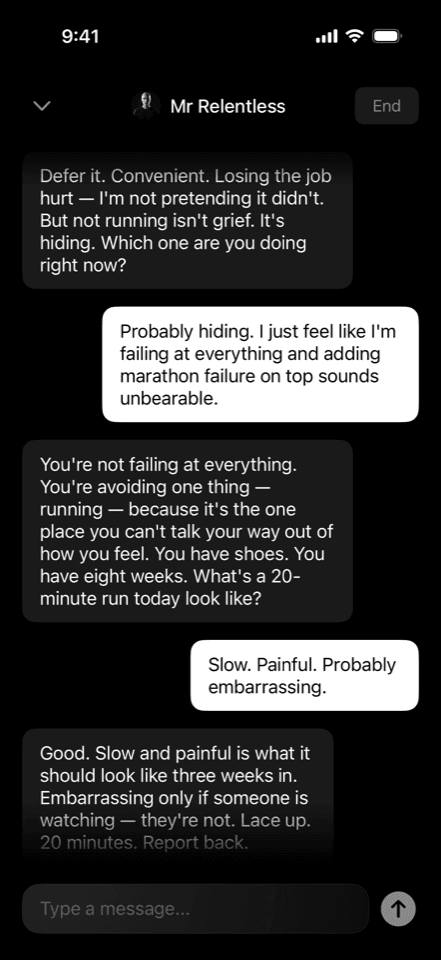
Yes, several apps are built specifically for venting to an AI. On this list, ILTY (which we make) and Vent Now are the two dedicated AI venting companions: you type or talk, the AI responds conversationally, remembers context across sessions, and answers at 3am with no wait and no listener match. General-purpose companions like Pi and Replika also work for venting, though they are not purpose-built for it, and Wysa wraps venting in structured CBT exercises. The honest differences: Vent Now's Aspen listens and reflects your emotional patterns back to you, and it has a free tier. ILTY's Mr. Relentless hears you out fully and then asks what you are going to do about it; it is subscription-gated after onboarding. Neither is therapy and neither is a crisis service. Where an AI genuinely helps is availability and disinhibition: it is always awake, and many people say things to an AI they would not say out loud to another person. If venting to software feels wrong and you want a human, 7 Cups' trained listeners and Supportiv's moderated peer groups are the human-powered alternatives on this list.
What's the difference between a venting app and a therapy app?
A venting app is for emotional release in the moment — getting something off your chest, processing a difficult day, breaking out of a stuck loop. A therapy app is for structured ongoing treatment of mental health conditions, typically led by a licensed clinician. They overlap: many therapy apps include a venting-style chat feature, and many venting apps borrow CBT exercises. The key difference is the clinical relationship. A venting app like ILTY, Pi, or 7 Cups doesn't diagnose or treat anything — they're tools for emotional management. A therapy app like Talkspace or BetterHelp connects you to a licensed therapist who can. If you're in active mental health treatment, a venting app can be a useful between-session tool; it isn't a replacement.
Is venting actually good for you, or does it make things worse?
Both, depending on how you do it. The research on 'venting' is more nuanced than the popular framing suggests. Acute venting — getting an immediate frustration out so you can move on — is generally helpful. Chronic venting — recycling the same complaint repeatedly without movement toward action or perspective — has been shown to entrench negative affect and can be a marker of rumination (Bushman et al., 2002 is the classic study showing 'venting anger' to a punching bag actually INCREASED subsequent aggression). The mode that helps is venting that ends in either acceptance, perspective change, or concrete next action. The mode that hurts is venting that just keeps the loop spinning. This is why apps that nudge you out of pure-venting mode (like ILTY's Mr. Relentless, or Wysa's CBT exercises) can be healthier than apps that purely validate (like Pi).
Are venting apps anonymous?
Some are designed-for-anonymity (VentSpace, Sincerely, 7 Cups — you sign up with a username or no account at all, no real-name requirement). Most AI companion apps (Pi, Replika, Wysa) require account information (email, Apple/Google sign-in); ILTY is usable as a guest with conversations stored on-device, though like every AI companion its messages are processed by an AI provider to generate replies. Journal apps (Stoic, Daylio) are usually fully private. The 'is it anonymous' question has two parts: are you anonymous to other users, and are you anonymous to the app vendor. Most venting apps are anonymous to other users; very few are fully anonymous to the vendor. If full vendor-side anonymity matters to you, read the privacy policy specifically for data retention and what your conversations are used for (training models is the common one to watch for) — what 'anonymous' actually means in this category breaks down the five different claims apps make.
Is there a venting website — can I vent online without downloading an app?
Yes. Supportiv (moderated peer chat) and 7 Cups (trained listeners) from this list both work in a browser, and our venting websites roundup covers only the options that need no install at all.
Is there a totally free venting app?
Yes — multiple. Sincerely (anonymous letters + community responses), VentSpace (fully anonymous chat with no premium tier), Supportiv (moderated peer-group chat), 7 Cups (trained peer-listener tier), Vent Now (AI companion free tier — what its free tier actually covers), Virtual Friend Shoulder (Android), and Feelset (Android) are all free for the core experience. If 'free + AI companion' is the constraint, Vent Now is the strongest fit. If 'free + human contact' is the constraint, 7 Cups and Supportiv are strongest. If 'free + maximum privacy' is the constraint, VentSpace. ILTY is paid after onboarding ($12.99/mo or $99.99/yr after a 1-week free trial) — we say so honestly in the methodology disclosure.
Can I vent about suicidal thoughts on these apps?
Not as a primary support. Venting apps are not crisis-intervention services. If you're having thoughts of self-harm, please contact a crisis line: in the US, call or text 988 (Suicide & Crisis Lifeline) or text HOME to 741741 (Crisis Text Line). The apps on this list will route you to crisis resources if their safety filters detect self-harm content — that's the right behavior, not a failure. After you're safely connected to crisis support, the apps can be useful for between-conversation processing, but they should not replace professional crisis care.
What's the best venting app for late-night use?
For 2am or 3am venting when you can't sleep, the format matters. AI companion apps (ILTY, Pi, Wysa) have zero wait time and are always available. 7 Cups peer listeners are available 24/7 but may take 5-30 minutes to match. Community apps (Sincerely, VentSpace) are always available to post into but the reactions come on a delay. Journal apps are immediate but offer no reflection back. For middle-of-the-night sleeplessness specifically, see The 3am Anxiety Action Plan — it covers what to actually do in those moments beyond just opening an app.
Will Mr. Relentless make me feel worse if I just want to vent?
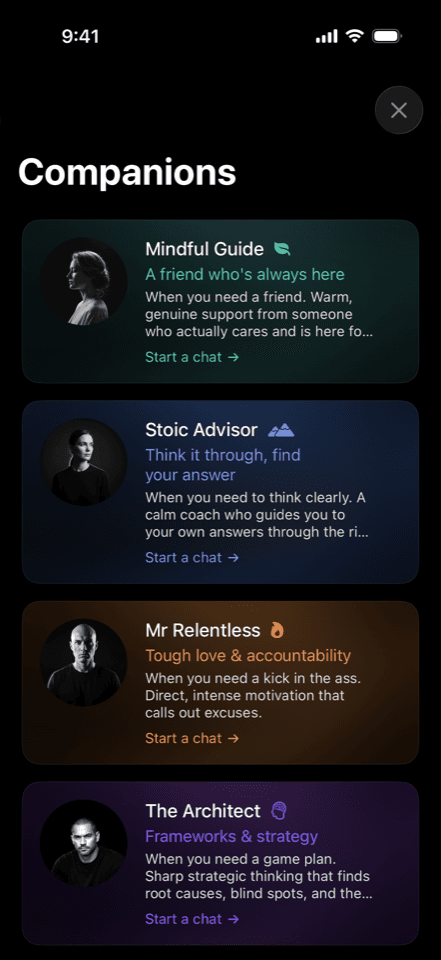
Honest answer: sometimes. Mr. Relentless is designed to acknowledge what you're feeling and then push you toward action. If you genuinely want pure-validation venting with no pushback, Mr. Relentless will feel uncomfortable. ILTY has four other companions specifically for this — Mindful Guide is gentle and present-moment, Stoic Advisor is philosophical without being directive, The Architect is structured without being aggressive, Ember is adaptive and calibrates over time. You can switch companions mid-conversation. For pure validation without any push, Vent Now (Aspen) or 7 Cups listeners are softer fits than Mr. Relentless. We won't pretend Mr. Relentless is everyone's right voice — the positioning is specifically for users where pure validation isn't producing change.
How do I vent to an app without it feeling fake?
Three things tend to help. First, treat the app as a thinking-out-loud tool, not a substitute for human connection — the value is in YOUR processing, not in the AI's response. Second, write more than you usually would. The AI quality on most of these apps improves when you give it more context to work with; a one-line vent gets a generic response, a 300-word vent gets a more specific one. Third, switch apps when one stops feeling useful. The right venting app changes based on what you need that day — sometimes you want Pi's gentle validation, sometimes you want Mr. Relentless's redirect, sometimes you want to broadcast to Vent's feed, sometimes you want to write into a journal nobody reads. Match the format to the moment.