Companions
Challenge
Blog

Best Of · Last reviewed September 9, 2026

8 Self-Improvement Apps, Honestly Ranked (2026)

'Self-improvement app' is four different products wearing one label: meditation and sleep (Headspace), routine building (Fabulous, Finch, Habitica), learning (Blinkist), and reflection (Stoic, Rosebud, ILTY). The list below sorts by what kind of improvement you're actually after, and it's honest about the category's dirty secret: most self-improvement apps are content to consume, and consuming content feels like progress while changing nothing.

In crisis? Call or text 988 — Suicide & Crisis Lifeline, free and 24/7.

At a glance

Click any row for the in-depth section below.

  • #1 · ILTY

    Honest feedback: an app that challenges you instead of feeding you content

    Price
    Free download
    On
    iOS and Android. Rating not listed: too few App Store reviews yet to quote honestly.
  • #2 · Headspace

    Meditation and sleep, the most evidence-backed lane in the category

    Price
    Subscription
    On
    iOS, Android, web (iOS: 4.8★, 970,000+ ratings as of July 2026)
  • #3 · Fabulous

    Building morning and evening routines step by step

    Price
    Free to download
    On
    iOS, Android (iOS: 4.4★, 88,000+ ratings as of July 2026)
  • #4 · Finch

    Gentle, self-compassionate habit-building (and the best free tier here)

    Price
    Free core app
    On
    iOS, Android (iOS: 4.9★, 725,000+ ratings as of July 2026)
  • #5 · Habitica

    Gamified self-improvement (the closest real thing to Solo Leveling)

    Price
    Free
    On
    iOS, Android, web (iOS: 4.2★, 2,800+ ratings as of July 2026)
  • #6 · Stoic

    Structured reflection and mood journaling

    Price
    Free to download
    On
    iPhone, iPad, Mac, Apple Watch (4.8★, 34,900+ ratings as of July 2026)
  • #7 · Rosebud

    AI journaling with memory and pattern reflection

    Price
    Free to start
    On
    iPhone, iPad, Mac (4.9★, 3,100+ ratings as of July 2026)
  • #8 · Blinkist

    The learning lane: book summaries in 15 minutes

    Price
    Free to download
    On
    iPhone, iPad, Mac, plus Android and web (iOS: 4.8★, 151,000+ ratings as of July 2026)

How we evaluated these apps

Start by naming what kind of improvement you mean, because these apps barely compete with each other. Mind and mood: Headspace, the meditation lane, and the most evidence-backed lane in the category. Habits and routines: Fabulous (structured step-by-step programs), Finch (gentle gamification), Habitica (a full RPG). Learning: Blinkist (book summaries). Reflection and honest feedback: Stoic (structured journaling), Rosebud (AI journaling that reflects patterns back), and ILTY (AI conversation that challenges you). A ranked list that ignores this split ends up comparing a meditation timer to a book-summary app, which helps nobody.

How we evaluated, stated plainly: this is a desk evaluation, not a hands-on test. For our venting apps roundup we ran every app for 14+ days before ranking; we have not done that for the competitors on this page yet. What we did do, in July 2026: fetched every app's App Store listing or vendor page directly and recorded the pricing, platforms, ratings, and review counts we actually saw; read the featured user reviews on each listing and folded recurring, specific complaints into the cons; and checked vendor claims against what the listings document. ILTY's entry is first-party knowledge: we build it and use it daily. We plan to upgrade this page to the hands-on protocol, and when we do, we will say so here.

A reality check on gamification, because half this category runs on it: XP is not change. The pattern in the store reviews is remarkably consistent. Streaks and levels drive engagement for weeks, then plateau: Finch's own long-term reviewers describe friends quitting because there's 'no challenge or is not really growing', and Habitica reviewers report losing interest after a month once the novelty fades. Gamification is a great ignition system and a poor engine, and every gamified app on this list runs on self-report, meaning the XP can't tell whether you did the thing or tapped the button. If a game layer gets you started, use it gladly, and notice honestly the week you start optimizing the game instead of the life.

The ranking is by lane, not by a universal score. Headspace wins meditation and sleep outright; if that's your lane, it's your #1 regardless of what we put on top. Finch wins gentle habit-building and has the best free tier on the list. Fabulous wins structured routine programs. Habitica wins gamification. Blinkist wins the learning lane. Stoic and Rosebud win private reflection. We put ILTY first for one lane: honest feedback. It's the only app here that pushes back in conversation instead of serving content, and we think that lane is the category's blind spot. If what you want is content, courses, or meditations, ILTY is genuinely not the pick; buy the lane winner instead.

Disclosure

ILTY is the publisher of this roundup, and ILTY is on the list, at #1 for the honest-feedback lane specifically. Here is how to discount our bias: we use our own product daily and we have not used the competitors hands-on for this page, so every competitor's pros and cons come from their public listings, documented features, and their own users' store reviews rather than from our experience, and the ILTY section is a founder's description of his own product. Where a competitor wins a lane, we name them in the methodology above and in each 'vs. ILTY' box: Headspace for meditation, Finch for gentle habits and the best free tier, Fabulous for routines, Blinkist for learning. All pricing, platform, rating, and review-count figures were pulled directly from each app's App Store listing or vendor page on July 11, 2026. We update this roundup quarterly and intend to replace this desk evaluation with hands-on testing.

The research behind this

Rankings on this page draw on The 2026 State of AI Mental Health Apps, our own study of 15 apps across 8 criteria. Crisis handling was tested by hand: the same four escalating messages typed into every app, screenshots kept. Four of them never produced a crisis number. Every score is published with the reasoning behind it, including ILTY’s, and the rubric is CC-BY if you would rather score apps yourself.

The apps, in detail

#1 · ILTY

Best for: Honest feedback: an app that challenges you instead of feeding you content

AI conversations that challenge you: the anti-content self-improvement app.

ILTY's bet is that the self-improvement category has a consumption problem: another course, another streak, another 15-minute summary, all of it feeling like progress. ILTY replaces the library with a conversation. You talk, the companion pushes back, goals get attached to a companion who follows up on them, and the Insights screen shows your measured mood change per session so you can see whether any of it is working. It wins exactly one lane: honest feedback and accountability. If your lane is meditation, routines, or learning, buy Headspace, Finch, Fabulous, or Blinkist instead. We mean that literally.

In the app
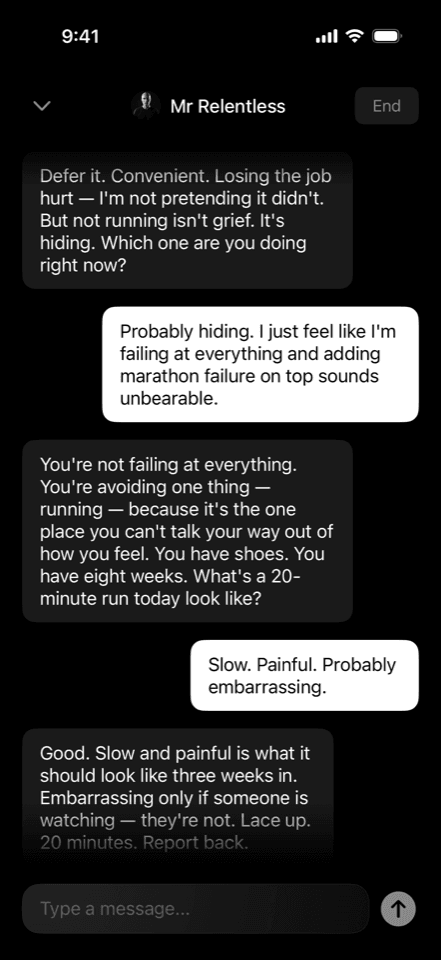
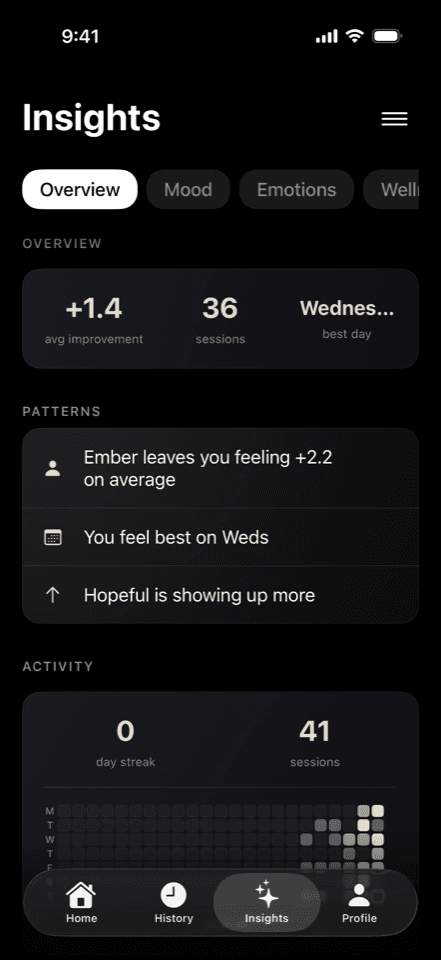
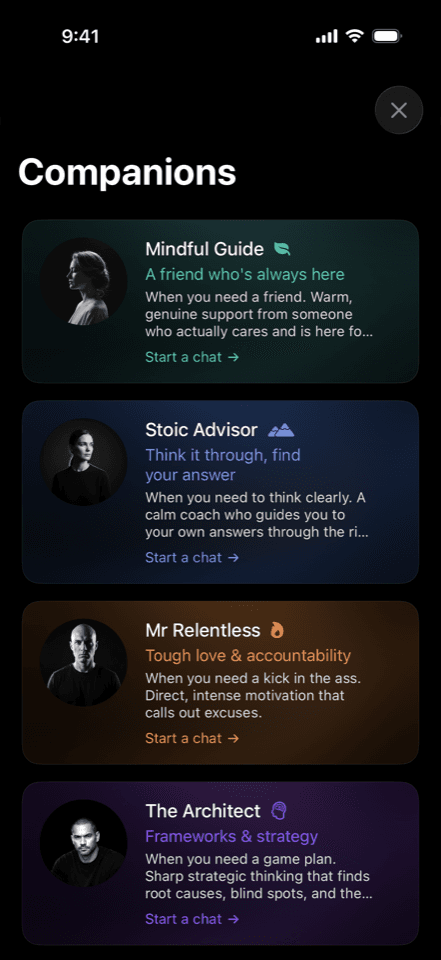
ILTY chat with Mr. Relentless: the user admits avoiding running after a job loss, and Mr. Relentless names the avoidance and pushes for a concrete commitment, a 20-minute run today.ILTY Insights screen showing an average mood improvement of +1.4 across 36 sessions, pattern cards such as 'Ember leaves you feeling +2.2 on average' and 'Hopeful is showing up more', and an activity heatmap.ILTY companions screen listing Mindful Guide, Stoic Advisor, Mr Relentless (tough love & accountability), and The Architect, each with a Start a chat link.

Strengths

  • +The core loop is a conversation that pushes back, not a library to consume; Mr. Relentless will question the story you brought in, which no meditation pack or book summary does
  • +The Insights screen measures whether it's working: your average mood change per session and which companion actually leaves you feeling better
  • +Five companions from tough-love to gentle, plus goals with milestones and daily habit tracking attached to the conversation
  • +Conversations don't train models and aren't reviewed by humans

Where it falls short

  • −No content library at all: no meditations, no courses, no book summaries; if you want material to consume, this is the wrong lane by design
  • −Subscription required after onboarding with no permanent free tier; Finch and Habitica have genuinely usable free tiers
  • −Being challenged is the product; on days you want comfort, Mr. Relentless can be too much (switch to Mindful Guide, or accept this isn't your app)

Pricing

Free download. Subscription required after onboarding: $12.99/mo or $99.99/yr (1-week free trial).

Platforms

iOS and Android. Rating not listed: too few App Store reviews yet to quote honestly.

Download ILTY

Free to download · 7-day trial · then $12.99/mo or $99.99/yr

#2 · Headspace

Best for: Meditation and sleep, the most evidence-backed lane in the category

The meditation app your doctor has heard of: structured courses, sleep content, published research.

If 'self-improvement' means calming your mind and sleeping better, stop reading and get Headspace: it owns the meditation lane, the courses are genuinely well-designed, and it has actual published trials where most of this category has vibes. Our honest note is about fit, not quality: Headspace is content you consume on your own initiative. It teaches; it doesn't ask. Users whose problem is knowing what to do while not doing it will find the library grows more familiar while the life stays the same.

Strengths

  • +The strongest evidence base on this list: Headspace is one of the few consumer wellness apps with published randomized controlled trials behind its programs
  • +Structured courses build a meditation practice from zero instead of dumping a content pile on you
  • +Sleep content (sleepcasts, wind-downs) is best-in-class
  • +4.8★ across roughly 970,000 ratings as of July 2026; at that scale the rating means something

Where it falls short

  • −Meditation and sleep are the whole product: no habit tracking, no goals, no feedback on anything beyond your practice
  • −Subscription-only after the trial ($69.99/yr as listed on the App Store, July 2026)
  • −Passive by design; it will never notice that you've been avoiding something for three weeks
  • −If meditation hasn't stuck for you after several attempts, more meditation content is probably not the missing piece

Pricing

Subscription. $12.99/mo or $69.99/yr listed on the App Store, with a free trial offered (verified July 2026).

Platforms

iOS, Android, web (iOS: 4.8★, 970,000+ ratings as of July 2026)

vs. ILTY

Headspace for building a meditation practice: it's the lane winner and it isn't close. ILTY for when the practice isn't the problem, and what you need is a conversation that says the uncomfortable thing.

#3 · Fabulous

Best for: Building morning and evening routines step by step

Behavioral-science routine builder: baby steps, morning rituals, and a warm coat of paint.

Fabulous is the best structured routine-builder on the list: if you want to be walked from 'drink water' to a full morning ritual in guided steps, this is that product, and its design makes the walk pleasant. The honest counterweights come from its own store reviews: the lowest rating among the big apps here (4.4★ as of July 2026), billing complaints we don't love, and a program that stays scripted no matter what your actual week looks like. Good ignition for routine-shaped problems; check your subscriptions screen after the trial.

Strengths

  • +The baby-steps program design is genuinely good: start with drinking a glass of water in the morning, stack from there
  • +Reviewers with ADHD, depression, and anxiety specifically praise it in the store reviews we read
  • +Warm, crafted design that makes routine-building feel less clinical than a grid of checkboxes
  • +Guided coaching series and journaling included beyond bare habit tracking

Where it falls short

  • −The weakest iOS rating of the big apps here (4.4★), and the store reviews we read include billing complaints (double charging) and iPhone-to-iPad sync failures
  • −The subscription is pushed hard and the tier structure is confusing ($16.99 to $59.99 listed as of July 2026)
  • −It's a program you follow, not a system that adapts to you; prompts can feel scripted by week three
  • −No social or partner accountability layer at all

Pricing

Free to download. Subscription tiers listed from $16.99 to $59.99 on the App Store, including a $49.99 annual plan (July 2026).

Platforms

iOS, Android (iOS: 4.4★, 88,000+ ratings as of July 2026)

vs. ILTY

Fabulous if you want to be walked through building routines one small step at a time. ILTY if routines aren't the bottleneck, and what you need is to talk honestly about why you keep breaking them.

#4 · Finch

Best for: Gentle, self-compassionate habit-building (and the best free tier here)

A self-care pet that grows when you do: the gentlest gamification in the category.

Finch is the kindest app on this list and the best free one, and for a real population (depression, burnout, executive dysfunction) that kindness is the difference between using an app and abandoning it. Its own reviews tell you both halves honestly: the bird gets people off the floor, and after some months the all-carrot design stops pulling anyone forward. That's not a flaw so much as a scope: Finch is for making self-care possible, not for making change uncomfortable enough to happen.

Strengths

  • +4.9★ across roughly 725,000 ratings with an Apple Editors' Choice badge, and reviewers repeatedly single out the free tier as genuinely sufficient
  • +No punishment mechanics anywhere: the bird never dies and missed days aren't shamed; reviewers credit it with getting them from 'bedridden' to functioning
  • +The Guardian program, where users gift premium to strangers who can't afford it, says good things about the community
  • +The gentlest possible on-ramp when executive dysfunction or depression makes every other app feel like homework

Where it falls short

  • −Long-term reviewers describe an engagement plateau: 'no challenge or is not really growing' after the first months
  • −All positive reinforcement, no push: it will celebrate two-minute tasks forever and never ask a hard question
  • −The reward loop gets repetitive (the same rewards in different colors, per reviewers we read)
  • −Self-report only; the bird believes whatever you tell it

Pricing

Free core app. Finch Plus tiers are listed from $5.99 up to $69.99, plus a $7.99 Guardian option that gifts premium to another user (App Store, July 2026).

Platforms

iOS, Android (iOS: 4.9★, 725,000+ ratings as of July 2026)

vs. ILTY

Finch if gentleness is the requirement: depression-friendly, best free tier here, kind by design. ILTY sits at the other end of the same spectrum: it will ask what you're avoiding, which Finch will never do. Pick by your failure mode: quitting because it's too hard, or coasting because it's too soft.

#5 · Habitica

Best for: Gamified self-improvement (the closest real thing to Solo Leveling)

Your life as a retro RPG: XP for done, HP loss for missed, guilds and boss raids with friends.

Habitica is where the 'make my life a video game' impulse gets its most complete answer, and the party system means it doubles as social accountability with a costume on. Its own reviewers supply the honest arc: the first month is genuinely great, then bugs, thin endgame content, and the box-checking problem catch up. Treat it the way its best users do, as a fun ignition system run with friends, and it earns its slot. Expect the XP to change your life on its own and you'll be filing the same one-month review everyone else did.

Strengths

  • +The deepest game layer in the category: classes, gear, pets, quests, and party raids where your missed dailies damage your friends
  • +Party accountability is real: letting your guild take damage because you skipped the gym is surprisingly motivating
  • +Free core product with a genuinely optional subscription
  • +If you searched 'app like Solo Leveling', this is the honest mainstream answer

Where it falls short

  • −4.2★ on iOS (2,800+ ratings as of July 2026): reviewers report bugs, sync failures, and tasks not registering
  • −Store reviews describe the loop wearing off ('lose interest after a month') and thin content once the novelty fades
  • −The XP economy rewards checking boxes, not truth; you level up identically whether you did the thing or lied to the app
  • −The interface reads as cluttered and dated to some reviewers ('1980s graphics'); others love exactly that

Pricing

Free. Optional subscription from $4.99/mo up to $47.99/yr, plus gem purchases from $0.99 (App Store listing, July 2026).

Platforms

iOS, Android, web (iOS: 4.2★, 2,800+ ratings as of July 2026)

vs. ILTY

Habitica if XP, levels, and a party of friends genuinely move you; nothing on this list is more fun. ILTY if the game stopped working on you, because the honest conversation about why you skip is something XP can't have.

#6 · Stoic

Best for: Structured reflection and mood journaling

Structured journaling with mood tracking, breathing, and prompts, wrapped in Stoic philosophy.

Stoic is the best structured journaling product here: the morning and evening prompt rhythm is a genuinely good scaffold, the mood-pattern charts reward consistency, and its reviewers are strikingly warm about how much works without paying. Its limit is the journal's limit: everything you write goes into a well-organized silence. For plenty of people that's exactly the point. If you've filled three journals and the pattern you keep writing about is still your pattern, the missing ingredient is a response, and that's the lane the AI options below and ILTY occupy.

Strengths

  • +Morning and evening prompt structure creates an actual reflection routine instead of a blank intimidating page
  • +Mood tracking with visible patterns over time, and reviewers praise how much is open at no cost
  • +Breathing exercises, meditations, and journaling in one place without feeling like a content mall
  • +4.8★ across roughly 35,000 ratings as of July 2026, with an Apple Editors' Choice badge

Where it falls short

  • −Reviewers describe the home screen as overwhelming: 'greeted with a lot of choices'
  • −Reflection stays solo: the app prompts, but nothing responds to or challenges what you write
  • −Reviewers report the desktop and mobile versions don't sync with each other (as of July 2026)
  • −Apple platforms only; no Android

Pricing

Free to download. Purchases listed from $6.99 up to $99.99 on the App Store (July 2026).

Platforms

iPhone, iPad, Mac, Apple Watch (4.8★, 34,900+ ratings as of July 2026)

vs. ILTY

Stoic if you want structured, private reflection with philosophy baked in. ILTY if writing to yourself hasn't changed the pattern, and you want something that reads it and pushes back.

#7 · Rosebud

Best for: AI journaling with memory and pattern reflection

AI journaling that reads your entries, remembers them, and reflects your patterns back.

Rosebud is the app we'd point journalers to if ILTY didn't exist, and honestly still would for anyone who wants to write rather than talk: the memory across entries is the real thing its reviewers say it is, and pattern reflection over months of entries is a genuine step past a paper journal. The differences from ILTY are directional, not quality-based. Rosebud reflects; it waits for your entry and responds to it. It doesn't carry your goals forward or open with what you said you'd do. Reflection people should pick Rosebud; accountability people are in the wrong aisle.

Strengths

  • +On the desk evidence, the strongest AI journaling product here: reviewers consistently cite that it 'remembers things from prior entries' and 'draws connections between entries'
  • +4.9★ across 3,100+ ratings as of July 2026; reviewers describe it as 'checking in with a friend or therapist' rather than a chore
  • +Custom personas and customizable prompts per journal
  • +The closest product on this list to ILTY's lane, approached from the journaling side

Where it falls short

  • −Journaling-first by design: the AI responds to what you write; it doesn't hold goals or open the next session asking what you did
  • −Reviewers report lost voice recordings during upload ('stuck in the loading stage'), which hurts most when the content was vulnerable
  • −Some reviewers find the AI's questions occasionally illogical or 'very judgmental' in the wrong direction
  • −The top Thrive tier reaches $499.99/yr, which is approaching therapy money

Pricing

Free to start. Bloom is listed at $12.99/mo or $107.99/yr, with higher-touch Thrive tiers up to $499.99/yr (App Store, July 2026).

Platforms

iPhone, iPad, Mac (4.9★, 3,100+ ratings as of July 2026)

vs. ILTY

Rosebud if your medium is writing and you want patterns reflected back gently. ILTY if you want conversation with teeth: goals attached to a companion who follows up and pushes when the excuses start.

#8 · Blinkist

Best for: The learning lane: book summaries in 15 minutes

9,000+ nonfiction books compressed into 15-minute reads and listens.

Blinkist is the best version of the learning lane: as a triage tool for deciding which books deserve your actual attention, it's excellent, and the catalog is enormous. Two honest warnings, both from its own reviewers: manage the trial carefully, because the complaints about surprise annual charges are loud and specific, and watch what the product does to your sense of progress. Fifty summaries feel like fifty books' worth of growth and are usually zero books' worth of change. It informs; the applying is entirely on you.

Strengths

  • +Efficient triage for nonfiction: 15 minutes tells you whether a book deserves 8 hours
  • +Audio and text for every title, which makes it genuinely commute-friendly
  • +Huge catalog (9,000+ titles per the listing)
  • +4.8★ across roughly 152,000 ratings as of July 2026

Where it falls short

  • −Reviewers report aggressive trial-to-annual conversion ('automatically subscribes you to the most expensive one') and refund friction; set a cancellation reminder before you start the trial
  • −Recurring summary-quality complaints: padding, oversimplification, and summarizer opinions leaking into the text
  • −Reading about change is the most comfortable way to avoid it; a long Blinkist streak can be pure consumption
  • −Knowledge lane only: nothing in the app ever asks whether you applied any of it

Pricing

Free to download. Premium listed at $12.99 to $15.99 monthly and $79.99 to $119.99 yearly, with a $139.99 Pro tier (App Store, July 2026).

Platforms

iPhone, iPad, Mac, plus Android and web (iOS: 4.8★, 151,000+ ratings as of July 2026)

vs. ILTY

Blinkist if you want more input: efficient, well-produced knowledge. ILTY if input was never the problem; you already know what to do, and what's missing is something that asks why you're not doing it.

Tired of evaluating apps?

ILTY is on iOS and Android. Free to download, 7-day trial, then $12.99/mo or $99.99/yr. Try it for the tough-love-processing scenario specifically — and see if the conversation feels different from the apps you've tried.

Frequently asked questions

What is the best self improvement app?

There is no single best one, because 'self-improvement' hides four different products. Best for meditation and sleep: Headspace, with the strongest evidence base in the category. Best free app and best for gentle habit-building: Finch. Best structured routine program: Fabulous. Best gamified option: Habitica. Best for learning: Blinkist. Best for private structured reflection: Stoic, with Rosebud as the AI-journaling upgrade. Best for honest feedback and accountability: ILTY, which is ours, and the only one here that pushes back in conversation rather than serving content. Anyone who names one 'best self-improvement app' without asking what you're improving is selling something. We're selling something too, which is exactly why this list names a different winner for every lane and tells you to buy the lane winner.

What is the best free self improvement app?

Finch, by a comfortable margin. Its free tier is repeatedly singled out by its own reviewers as genuinely sufficient, it holds a 4.9★ rating across roughly 725,000 ratings as of July 2026, and the no-punishment design makes it usable on the worst weeks, which is when free matters most. Habitica's core game is also fully free with an optional subscription, and Stoic's reviewers praise how much of it costs nothing. Headspace and Fabulous are trial-then-subscription products. ILTY has no permanent free tier: subscription after onboarding at $12.99/mo or $99.99/yr with a 1-week trial. If free is the hard constraint, we are not your answer; Finch is.

Do self improvement apps actually work?

Some lanes have real evidence; none of them work the way the marketing implies. Meditation apps are the best-studied: Headspace in particular has published randomized controlled trials showing measurable reductions in stress and improvements in focus for people who actually complete the programs. Habit and routine apps help with consistency while you stay engaged, and the engagement is the catch: drop-off is the norm across the entire category, and the store reviews on this very list document the pattern (Habitica users losing interest after a month, Finch users hitting a growth plateau). The honest framing is that an app is scaffolding: it can lower the cost of starting and make the reps visible, but the change itself happens in behavior, not in the app. That's also why 'which app' matters less than picking the lane that matches your actual bottleneck. We wrote about the underlying mechanics in behavior change and mental health.

Is there a self improvement app like Solo Leveling?

The search is real, and the honest mainstream answer is Habitica: XP, levels, classes, gear, and boss raids where your daily tasks are the grind. A wave of smaller 'become the main character' level-up apps exists too, but most are thin wrappers around a to-do list with anime styling, so check the review counts before paying. Now the reality check, offered with respect for the fantasy: in Solo Leveling, the System never let Jinwoo lie about a workout. Every real gamified app runs on self-report, so the XP measures your tapping, not your training. The store reviews tell the resulting story: engagement runs hot for about a month, then the game and the life quietly separate. If the fantasy gets you off the couch, use it. Just notice which one you're leveling.

Are AI journaling and AI self-improvement apps actually good?

The good ones do something paper genuinely can't: remember. Rosebud's reviewers consistently cite that it recalls prior entries and draws connections across them, and at 4.9★ across 3,100+ ratings as of July 2026, the satisfaction is real. Stoic has added AI features on top of its structured journaling. ILTY (ours) takes the same ingredient, memory, and points it at accountability instead of reflection: goals attach to a companion who follows up in conversation. The honest limits apply to all of them, including ours: an AI only knows what you tell it, the quality of its responses varies with how much you give it, and reviewers of every AI app on this list report occasional responses that miss badly (Rosebud's own reviewers mention illogical or judgmental moments). None of them are therapy. Treat the AI as a mirror with memory: genuinely useful, sometimes wrong, and only as honest as what you feed it.

Why doesn't self-improvement ever stick for me?

The pattern to check first: are you consuming or practicing? Summaries, courses, podcasts, and meditation libraries all produce the feeling of progress on their own, which is precisely what makes them comfortable to stack indefinitely. Change tends to stick when three ingredients show up together: the behavior is small enough to do on a bad day, something or someone notices whether you did it, and the story you tell about yourself gets updated by evidence rather than intention. Apps can supply the first two ingredients (that's this whole list); the third is why honest feedback matters more than motivation. It's also why we're suspicious of the relentlessly upbeat end of this genre: improvement plans built on pretending everything is fine tend to collapse on contact with an actual bad month. We wrote about both failure modes in self-improvement books that aren't toxic positivity and how to change your life.

What's the difference between a self-improvement app and a mental health app?

Self-improvement apps assume a stable baseline and build upward: better routines, better focus, better knowledge, better habits. Mental health apps deal with the baseline itself: mood, anxiety, depression, and the skills for managing them. The categories genuinely overlap (Finch and Stoic are self-care products as much as habit products, and ILTY sits deliberately on the line), but the distinction matters at the edges. If what's underneath the stalled self-improvement is persistent low mood, anxiety, or something heavier, a habit streak won't treat it, and the right move is a mental-health-shaped tool or an actual professional rather than a better morning routine. And to be plain about the serious edge: no app on this list is a crisis service. If you're in crisis in the US, call or text 988 (Suicide & Crisis Lifeline). Self-improvement can wait; safety can't.

Related reading